Komodo
We visit the UNESCO World Heritage Site and Biosphere Reserve. The park is 200 nautical miles east of Bali and right between the large island of Sumbawa and Flores in Indonesia, all of which are part of the Lesser Sunda Islands. Accepted under the UNESCO Man and the Biosphere Programme in January 1977, and officially declared a World Heritage Site in 1991, the Komodo National Park encompasses 132,000 hectares of marine waters, making it one of the largest protected zones in the world.

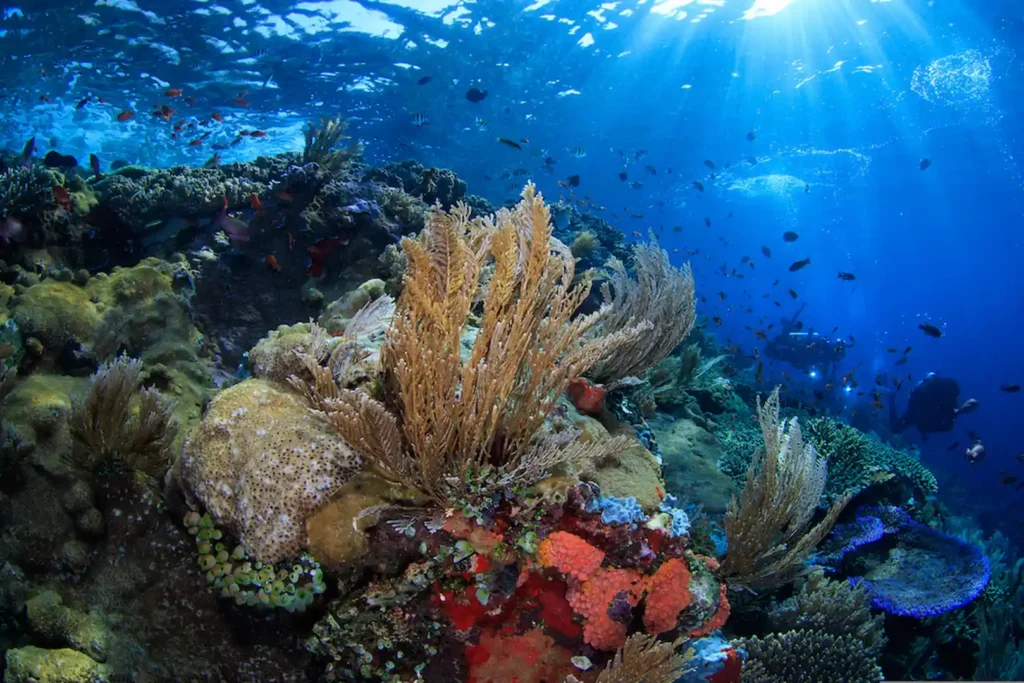
Diving in Komodo National Park is best done by liveaboard, which allows you to explore the area to its fullest. The park and surrounding area boast one of the world’s richest marine environments, with over 260 species of reef-building coral, 70 species of sponge, marine worms, molluscs, echinoderms, crustaceans, over 1,000 species of cartilaginous and bony fish, marine reptiles, and marine mammals.
Some notable marine species include pygmy seahorses, anglerfish, nudibranchs, manta rays, dolphins, Napoleon wrasse, and groupers. A visit to Komodo National Park wouldn’t be complete without encountering the world-famous dragons.
In Komodo, the waters are highly varied with beautiful stretches of shallow coral reefs, deep walls, and pinnacles, as well as current-swept volcanic mounts. The islands host a variety of different life as well. Macro lovers will find a wealth of critters such as shrimp, frogfish, and nudibranch. Being inside the coral triangle, diving in Komodo offers a wide variety of reefs that are humming with activity; it can be enough just to sit and watch the comings and goings. Komodo is home to several reef-building corals, hence its protected status.
Mola mola are also frequent visitors to Komodo, drawn by strong currents and rich waters. More occasional visitors are whales and dolphins, which are attracted by the plankton-rich waters. There is even a small chance that you might see a whale shark passing by.